A guide to the identity and funding questions some Melbourne buyers may now face earlier in the process, as new AML/CTF regulations come into effect for the real estate industry, and what to sort out before making an offer or bidding at auction.
Audience: owner-occupiers, first home buyers and upgraders
Category: Buyer Education
Quick Answer
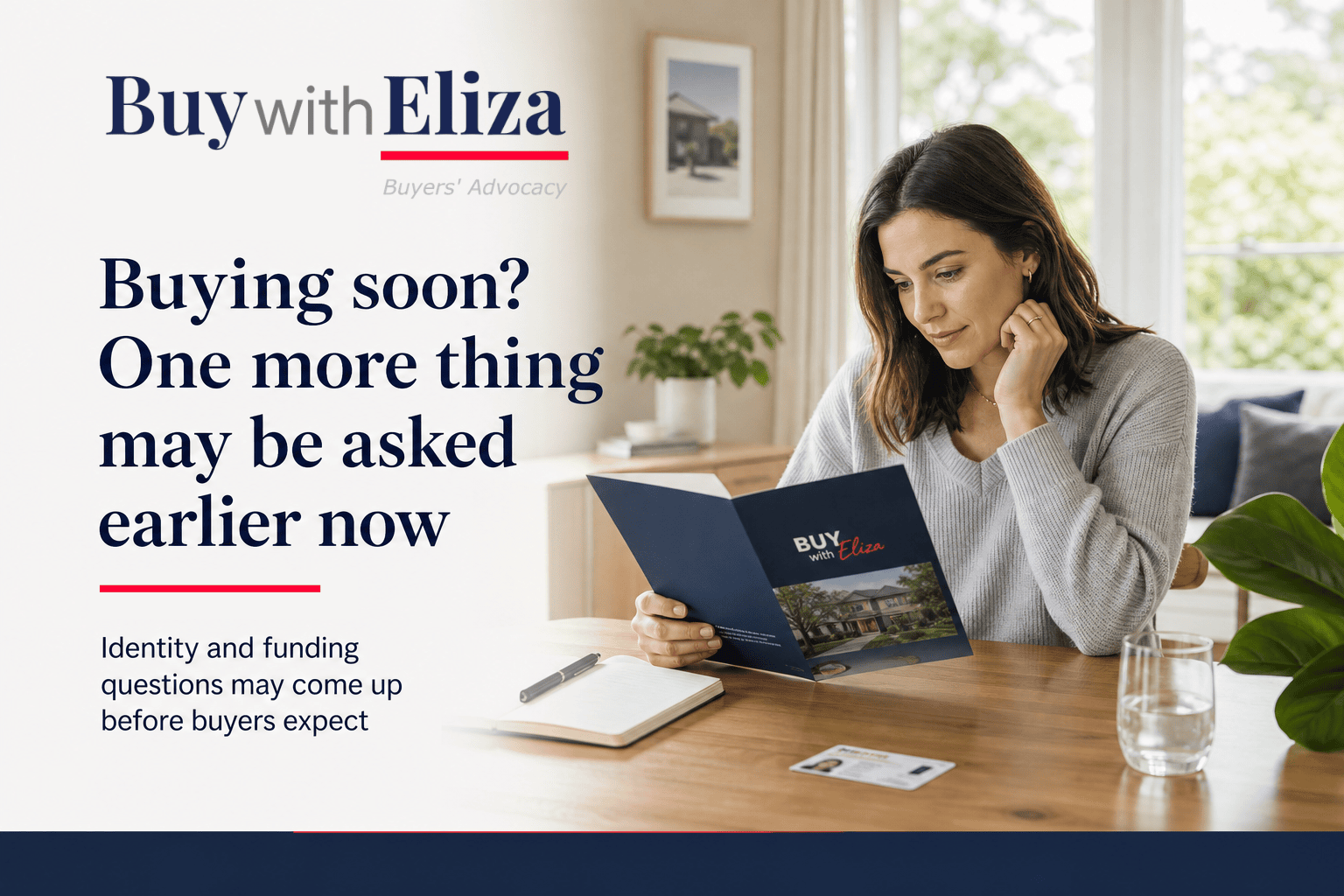
From 1 July 2026, some real estate businesses may ask property buyers to prove their identity and explain where their purchase funds are coming from earlier in the process than they might expect. If you are buying with savings, loan funds, sale proceeds, family help, or a mix of those, it is sensible to know how you will explain this and have the records ready to support you.
That does not mean every buyer will be asked the same questions at the same time. It does mean some buyers will run into these questions before they expected to, including before an offer is accepted or before auction week.
Buying a home in Melbourne already asks a lot of buyers. You are trying to judge the property itself, work through the Statement of Information and Section 32, line up finance, and make sensible decisions without getting pushed around. [5, 6 ,8]
From 1 July 2026, some buyers may also be asked to prove who they are and explain where the money for the purchase is coming from earlier than they would have expected before. [1 ,3, 4]
For plenty of buyers, that will be fine. But if your deposit or purchase funds are coming from several places, or family is helping, it is much better to sort that out before you become attached to a property or trying to get ready for auction.
Before You Read Further
This article is general information for Melbourne property buyers. It is not legal, tax, lending, or personal financial advice. If you need advice about contracts, finance, trust structures, or AML questions in your own transaction, speak with your relevant adviser.
CHECK POINT
Could you explain your funds clearly if someone asked this week?
Your funds
Can you explain where the deposit and purchase money are coming from, in plain language?
Family help
If family is contributing, can you explain what they are providing and what records you already have?
Who asks what
Do you know which business in your buying process is most likely to ask identity or funding questions first?
Auction timing
If you plan to buy at auction, is this already sorted early enough that missing paperwork does not become a problem in the final days before bidding?
next steps
Make your property buying journey smoother.
If this article has highlighted a few things you had not thought about yet, that is usually a sign to get the right support in place early.
Buying property involves more than finding the right home. It also means being ready for the questions, decisions, and moving parts that come with the process.
Why Buyers Are Noticing This Now
From 1 July 2026, some real estate businesses become subject to anti-money laundering and counter-terrorism financing obligations, including buyer's agents and seller's agents involved in property sales. [3, 4]
In plain English, that means identity and funding questions may become a more visible part of the property buying process. Some businesses may ask for information they did not previously need, while others may need it earlier than buyers expect.
It also means buyers may be asked similar questions more than once. A selling agent, buyers advocate, conveyancer, lender, or other business involved in the transaction may each have their own obligations. One business generally cannot simply rely on another business having completed those checks. Each may need to collect the information directly from the buyer, although the level of detail requested may vary.
This matters most when the money is not coming from one clean, simple source. Savings plus a loan is one thing. Savings plus, sale proceeds from another property, plus help from family is another. Neither is unusual. One just takes more explaining. [1, 2]
What Buyers May Be Asked to Explain
At the simplest level, you may be asked to prove you are who you say you are. That can include your full name, residential address, date of birth, and photo identification.
You may also be asked a more practical question: what money is paying for this property and where is it coming from? That could include savings, a home loan, sale proceeds from another property, family help, or a mix of those.
If a form refers to source of funds, read that as where the money for this purchase has actually come from. AUSTRAC's examples include wages, business income, dividends, sale proceeds, gifts, and inheritance. If it refers to source of wealth, the question is broader. It is asking how you built your assets overall, not only the dollars going into this purchase. [2]
If you are buying through a trust or another legal structure, expect more questions and to provide a more detailed document trail than a purchase in your own name. [1]
How This Can Look in Practice
A common owner-occupier scenario might be a purchase funded by savings, a home loan, and a gift from family. None of that is unusual by itself. The practical issue is being able to explain that funding mix clearly, including who contributed what and why, if a business asks.
What may feel different is that the buyer may need to provide identity and funding information to more than one organisation involved in the purchase. This may include their lender, solicitor or conveyancer, buyer’s advocate, and the real estate agent acting for the seller. Each business may have its own AML obligations and may need to collect information directly from the buyer rather than relying on checks completed by another business. [1, 2, 3]
If family help is involved, or the funds are coming from more than one place, it is sensible to expect that a quick verbal explanation will not be enough. Different businesses may collect different supporting information or ask follow-up questions in different ways.
There may not be one universal checklist that covers every buyer or every business. What does help is being able to explain the story clearly, prepare the relevant supporting documentation in advance, and understand that the same funding story may need to be provided more than once during your buying process.
How This Fits into the Victorian Property Buying Process
Private sale
Consumer Affairs Victoria says private sale offers can be made subject to conditions such as finance, sale of an existing property, or a building or pest inspection. Eligible private sales may also come with a cooling-off period.
A private sale may give buyers more time and flexibility than an auction environment, but it does not remove the need to answer identity and funding questions. Those questions may still be asked, and supporting evidence may need to be provided, before an offer would normally be accepted.
That means buyers should not assume they can leave this until after they have found the right property. It is still important to have identity documents, a clear funding explanation, and supporting records ready before making an offer.
Auction
Consumer Affairs Victoria says buyers generally accept the displayed contract terms by bidding, cannot usually negotiate conditions afterwards without the seller's agreement, and do not get a cooling-off period after a successful auction purchase. [8]
That makes preparation even more important. If you are planning to bid at auction, you should have your identity documents, funding explanation, and supporting evidence organised before auction day. You do not want to be trying to explain family contributions, loan funds, deposit money, or sale proceeds at the last minute - let alone tracking down documentation that supports your funding arrangements.
In practice, buyers may increasingly be asked to provide some of this information before they participate in an auction. That will not make the AML framework different for auctions, but it may change the timing. The practical point is simple: auction buyers have less flexibility, so the funding story and document trail need to be clear before they bid.
Practical Issues to Watch For
One common problem is getting deep into the property search adventure before you can clearly explain how the deposit and purchase funds are coming together. That can feel manageable until a real property that yoiu fall in love with puts a deadline in front of you.
Another is family help. A gift or transfer from parents may sound simple in conversation, but it can become harder to explain quickly when an offer or bidding decision is in progress. In certain circumstances you may be required to not only show evidence of the transfer, but also identification evidence of the people making the transfer.
Buyers can assume that the property due diligence process will cover funding checks. Reviewing the contract, checking the Section 32, arranging building and pest inspections, and confirming finance are all part of working out whether the property is the right purchase. AML checks are different. They are about who the buyer is, where the money is coming from, and whether the business involved in the transaction has met its own compliance obligations.
That means a buyer can be well prepared on the property side and still be delayed if their identity documents, funding explanation, or supporting records are not ready.
The other common issue is timing. These questions are much easier to deal with when they are asked early. If identity checks, funding explanations, or supporting documents are left until the buyer is ready to make an offer or bid at auction, they can create avoidable pressure at exactly the wrong time.
A Simple Pre-Offer Buyer AML File
A buyer AML file does not need to be complicated. The aim is to have your identity, funding story, and supporting records organised before you are ready to make an offer or bid at auction.
This can make the process easier if your lender, conveyancer, buyer’s advocate, or the selling agent asks for information as part of their AML checks.
Your buyer file should include:
- Identity documents: Keep a clear copy of your current photo identification, such as your driver licence or passport. If more than one person is buying the property, each buyer should have their own identification ready.
- Basic buyer details: Prepare the basic details that may be needed by the businesses involved in the purchase, including your full legal name, current residential address, date of birth, and contact details. If you are buying in joint names, the details of each buyer will need to be documented properly. This means each buyer should be ready to provide their own identity information and any other details needed to show who is involved in the purchase. If the property will be bought through a company, trust, or other structure, additional information may be needed about that entity and the people behind it.
- Funding summary: Write a short plain-English explanation of how the purchase will be funded. For example, this might include savings, a home loan, sale proceeds from another property, family assistance, inheritance, or a combination of sources. The aim is not to write a long document. The aim is to make the funding story clear.
- Deposit funds: Keep records showing where the deposit money is coming from. This may include bank statements, savings records, term deposit records, evidence of funds being transferred, or other documents that explain the source of the deposit.
- Loan or financing information: Keep any finance or pre-approval information you already have. This is still part of the broader buying process, but it can also help explain how the purchase will be funded.
- Family help, gifts, or loans: If family or another person is helping with the purchase, make sure you can explain what they are contributing and whether it is a gift, loan, guarantee, or another arrangement. Helpful records may include a gift letter, loan agreement, transfer record, or other documents showing where the money is coming from and why it is being provided.
- Sale proceeds, inheritance, or other larger fund sources: If part of the purchase is being funded from the proceeds of a property sale, inheritance, business funds, trust money, overseas funds, or another larger source, keep records that help explain that source. This may include a contract of sale, settlement statement, probate or estate documents, business records, trust documents, bank statements, or transfer records, depending on the situation.
- Professional contact details: Keep the contact details for your conveyancer or legal practitioner, lender or mortgage broker, and buyer’s advocate if you are using one.
Questions to resolve Early
Before making an offer or bidding at auction, ask yourself:
- Can I explain where each part of my deposit and purchase funds is coming from?
- Do I have records that support that explanation?
- If someone else is helping me buy, can I explain who they are, what they are contributing, and why?
- If my funds are coming from a trust, company, overseas account, inheritance, business sale, or another less common source, do I know what documents may be needed?
- If I am planning to bid at auction, is anything still unclear that could create a problem on auction day?
The point of this file is simple. When a business asks identity or funding questions, you want to be able to respond clearly and quickly, rather than trying to pull the story together under pressure.
The Takeaway.
The takeaway is simple. Before you get serious about a property, make sure you can clearly explain who is buying, how the deposit and purchase funds are being assembled, and which documents may need to be ready before an offer or auction.
That does not mean you need to become an AML expert. It means you need to be organised enough that identity and funding questions do not distract you from the bigger decision: whether the property is right for you.
This is where Buy with Elizacan help.
Buy with Eliza does not replace your conveyancer, lender, mortgage broker, accountant, or tax adviser. Our role is different. We help buyers stay organised, compare properties clearly, understand the practical steps in the buying process, and keep their focus on finding and securing the right property for their needs.
If you are planning to buy in Melbourne and want practical help finding the right property, assessing it properly, and giving yourself the best chance of securing it, book a call with Eliza.
Frequently Asked Questions
Questions buyers are asking about their property
sources
Reference material used in this article
- Information you need to provide when you buy a property, AUSTRAC.
- Proof of source of funds and source of wealth, AUSTRAC.
- Real estate designated services, AUSTRAC.
- Preparing for the changes if you’re newly regulated, AUSTRAC.
- Understanding property prices and underquoting for buyers, Consumer Affairs Victoria.
- Seek expert advice on property, Consumer Affairs Victoria.
- Buying property by private sale, Consumer Affairs Victoria.
- Buying property at auction, Consumer Affairs Victoria.